Top Office Interior Design Trends in India for Modern Workspaces
The Indian workplace is undergoing a profound transformation. Gone are the days of drab, cubicle-filled floors and sterile lighting. As we progress through 2026, the office has evolved from a mere place to work into a strategic asset designed to foster collaboration, enhance well-being, and reflect brand identity. With hybrid work models now the norm, companies across India—from metro cities to emerging tier-2 hubs—are reimagining their interiors to lure employees back with spaces that are as comfortable and engaging as they are functional .
If you are planning to redesign your workspace, here is a comprehensive guide to the top office interior design trends in India that are shaping the modern work experience.
1. The Rise of the Hybrid-First and Agile Workspace
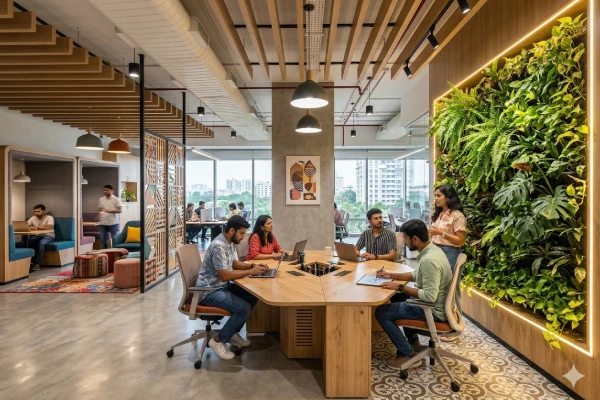
The traditional concept of a fixed desk for every employee is rapidly becoming obsolete. In its place, the hybrid-first design has taken center stage. Modern offices are now ecosystems designed for purpose, not just headcount. We are seeing a significant shift toward collaboration-centred environments, featuring open zones, project rooms, and team clusters that encourage spontaneous interaction .
This doesn’t mean privacy is forgotten. To support deep focus work, designers are incorporating quiet zones, focus pods, and “decompression spaces.” The goal is to create a balance between “we” space and “me” space, allowing employees to choose the right setting for the task at hand, whether it’s a team brainstorming session or a video call requiring absolute silence . According to experts, the future workspace is less about desk density and more about “purpose density” .
2. Wellness and Ergonomics: A Non-Negotiable Investment
Employee well-being is no longer just a buzzword; it is a business priority driving interior design decisions. The pandemic permanently raised awareness about the health impacts of poor posture and sedentary lifestyles. Consequently, there is an increased demand for workplace ergonomic products .
We aren’t just talking about basic chairs anymore. Corporates are proactively investing in high-quality task chairs, height-adjustable desks, keyboard systems, and monitor arms as part of their wellness programs . This surge in demand is reflected in the market itself: the India Ergonomic Chair Market was valued at USD 370.26 Million in 2024 and is projected to nearly triple to USD 950.1 Million by 2033 . This data underscores a cultural shift where companies view ergonomics not as an expense, but as a critical investment in employee retention, productivity, and long-term health .
3. Modern Lighting: The Era of Linear and Profile LEDs
Lighting has emerged as a hero element in modern office design, moving far beyond the flickering fluorescent tube. The trend for 2026 is unmistakably leaning toward sleek, architectural, and smart lighting solutions. Designers are ditching conventional fixtures in favour of linear and profile LED lights that shape the mood and highlight the architecture of a space .
These lighting solutions are popular because they offer seamless, uniform illumination without visible bulbs or glare. In practice, this means:
- Linear LED lights are being used extensively in conference rooms, receptions, and corridors to create a clean, modern aesthetic .
- Profile LED lights, which use aluminum channels to hide LED strips, are perfect for adding a premium touch to workstations, false ceiling coves, and even shelving units .
Beyond aesthetics, these systems align with India’s push for energy efficiency. They consume less power, have longer lifespans, and are increasingly integrated with smart controls, dimmers, and motion sensors to optimise energy use .
4. Biophilic Design and Material Intelligence
As offices strive to feel less “corporate” and more “human,” we are seeing a beautiful integration of nature and natural materials. Biophilic design—which incorporates natural elements like light, plants, and water—is being used to reduce stress and improve cognitive function .
This trend goes hand-in-hand with what experts call “material intelligence.” There is a growing preference for warm, tactile finishes that improve user comfort. We are moving away from cold, synthetic materials toward:
- Natural woods and stone.
- Low-VOC (Volatile Organic Compound) paints and materials that improve indoor air quality .
- Handcrafted furniture that brings authenticity and warmth to the workspace .
This shift toward handcrafted pieces is particularly notable in India, where traditional craft techniques are being blended with contemporary forms to create furniture that feels both rooted and cosmopolitan .
5. Sustainability: From Certification to Practice
Indian businesses are no longer treating sustainability as a mere checkbox for certification. It has become a core design principle. According to Colliers” 2026 Asia Pacific Workplace Insights report, India stands ahead of regional counterparts in prioritising sustainability, with more than 80% of upcoming Grade A office supply expected to be green-certified .
In practical design terms, this means:
- Using materials with lower embodied carbon.
- Choosing modular construction methods that allow for faster, cleaner implementation and less waste .
- Implementing energy-efficient lighting and HVAC systems.
- Specifying furniture and finishes that are durable, circular, and responsibly sourced .
Corporates are now partnering with landlords on sustainability initiatives, driving demand for transparent sourcing and designs that minimise environmental impact .
6. The Tech-Integrated and Smart Workspace
Finally, technology is being woven into the very fabric of the office. The convergence of design and technology is defining the next generation of commercial furniture and spaces. We are moving toward smart offices equipped with sensor-enabled furniture and data-driven space utilisation tools .
Imagine desks that alert facilities when they need cleaning, or meeting rooms that automatically adjust lighting and temperature based on occupancy. IoT-enabled LED lights with Wi-Fi and voice control allow employees to personalise their immediate environment . Furthermore, with the rise of AI, about 20% of organisations are now using the technology to enhance employee experience through occupancy analytics and workspace optimisation .
Conclusion
The modern Indian workspace is a dynamic blend of flexibility, technology, and humanity. Whether it’s through the adoption of ergonomic furniture that cares for the body, the installation of linear LED lighting that soothes the eyes, or the integration of handcrafted pieces that warm the soul, the focus is firmly on creating people-centric environments .
As we look toward the future, the offices that thrive will be those that successfully balance collaborative energy with quiet focus, and technological innovation with sustainable, natural warmth. For Indian businesses, the message is clear: a well-designed office is one of the most powerful tools for attracting talent, strengthening culture, and driving performance in 2026 and beyond .
This is Photoshop\’s version of lorem ipsum. Lorem Ipsum is simply dummy text of the printing and typesetting industry. Lorem Ipsum has been the industry\’s standard dummy text ever since the 1500 Lorem Ipsum is simply dummy text of the printing and typesetting industry. Lorem Ipsum
Sed ut perspiciatis unde omnis iste natus error sit voluptatem accusantium doloremque laudantium, totam rem aperiam, eaque ipsa quae ab illo inventore veritatis et quasi architecto beatae vitae dicta sunt explicabo
This is Photoshop\’s version of lorem ipsum. Lorem Ipsum is simply dummy text of the printing and typesetting industry. Lorem Ipsum has been the industry\’s standard dummy text ever since the 1500